Suppose a farmer plants their maize in November like others have done for years, only to watch the seed sit in dry soil for weeks. Are farmers still trusting current rainfall patterns? Do traditional planting dates still work the way they used to? Across Zambia, farmers are adjusting their planting dates because rainfall patterns are becoming less predictable. Here’s a detailed analysis of how rainfall patterns have changed over the years.
For generations, planting schedules were guided by seasonal rainfall patterns. The first meaningful rains usually arrived between late October and early November, and planting followed shortly afterward.
Rainfall patterns are becoming less predictable
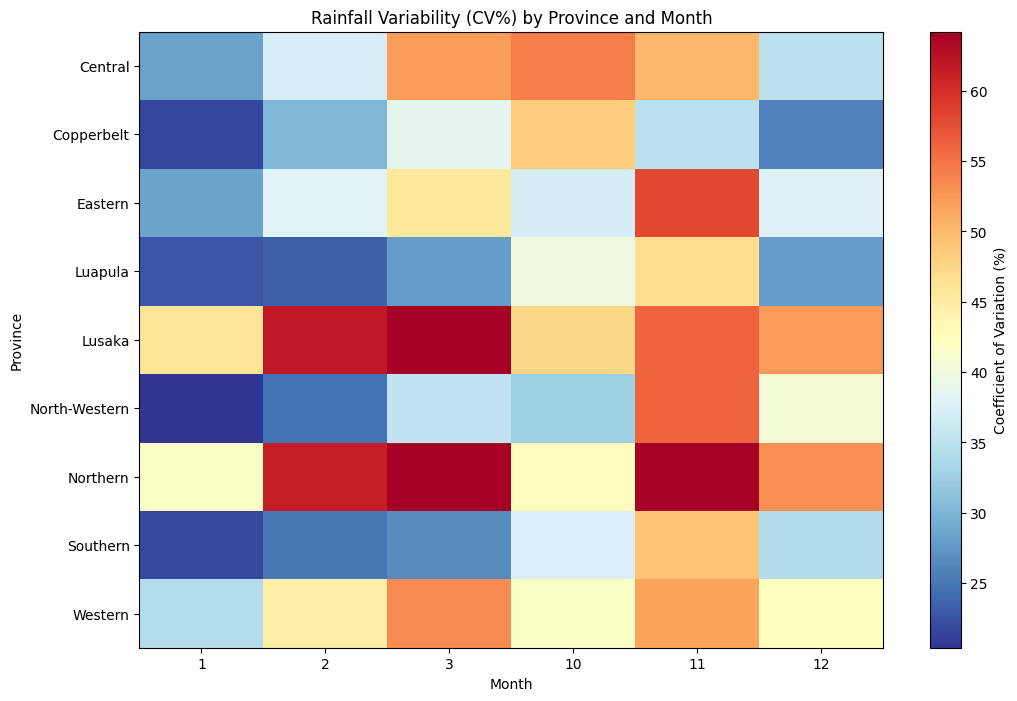
In our analysis, we found that October, which is traditionally used for planting, contributes only about 15% of total seasonal rainfall across most provinces on average. At the same time, the reliability of October rains has declined, especially in drier regions like Lusaka and Southern Province which makes this average slightly higher. In some cases, low October rainfall years have increased from around 20% historically to nearly 50% in recent decades.
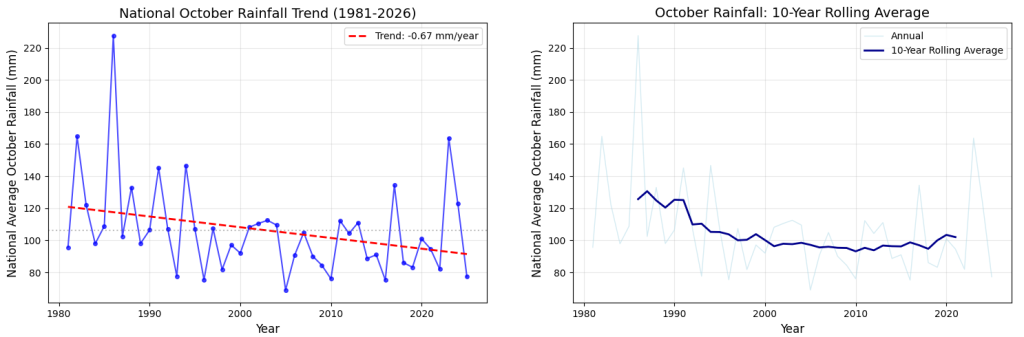
Climate data also shows that rainfall variability has increased across Southern Africa. According to the Zambia Meteorological Department, rainfall onset has become more erratic in several parts of the country. Some seasons start later, while others bring heavy rainfall in short periods rather than steady rains.
Studies published by the Food and Agriculture Organization and the Intergovernmental Panel on Climate Change (IPCC) indicate that climate change is likely to increase this variability in the region. For farmers, this creates a difficult situation.
- Plant too early, and seeds may fail if the rains stop.
- Plant too late, and crops may not mature before the end of the rainy season.
Because of this uncertainty, farmers are adjusting their planting decisions.
You might also like: Importance of crop rotation
Farmers are shifting planting strategies
In many farming communities, planting is now happening later than it used to. Instead of planting immediately after the first rain, farmers often wait for:
- two or three consistent rainfall events
- soil moisture to stabilize
- weather forecasts indicating continued rainfall
Agricultural extension officers increasingly advise farmers not to rush planting after the first rain.
This approach reduces the risk of crop failure caused by false starts to the rainy season. This adjustment is not just based on observation. Our findings show that rainfall patterns show that the start of the season is becoming less reliable, while a larger share of rainfall is shifting into the middle and later parts of the season. In provinces like Eastern and Lusaka, late-season rainfall in March can contribute more than 20% of total rainfall, meaning crops planted too early may not align well with moisture availability later in the season.
Early-maturing crop varieties are becoming important
Another response to changing rainfall patterns is the use of early-maturing seed varieties. Traditional maize varieties may take around 120 to 150 days to mature. Early-maturing varieties can mature in 90 to 110 days.
Seed companies and research institutions such as the Zambia Agricultural Research Institute (ZARI) have promoted these varieties because they help farmers adapt to shorter or unpredictable growing seasons.
Early-maturing crops are particularly useful in areas where the rainy season sometimes ends earlier than expected. However, these varieties can sometimes produce lower yields compared to longer-season varieties if rainfall conditions are good.
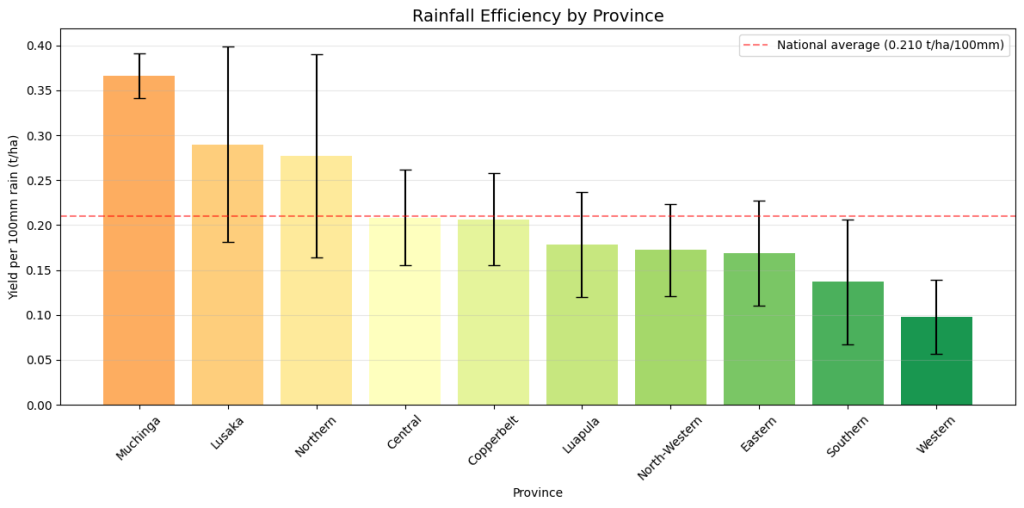
From our analysis, the differences across provinces make this even clearer. Lusaka, one of the driest provinces, produces significantly more maize per unit of rainfall than wetter regions like Western Province. In fact, Lusaka produces roughly three times more maize per 100mm of rainfall than Western. This shows that yield is not driven by rainfall alone, but by how efficiently that rainfall is used.
Climate change is affecting more than planting dates
In high rainfall regions such as Luapula, more rain does not always improve yields. In fact, based on our data, we see a negative relationship between rainfall and yield in some of these areas. Excess rainfall leads to waterlogging, nutrient loss, and reduced crop performance. This is why some of the wettest provinces do not produce the highest yields.
Changing rainfall patterns also affect other parts of farming. Farmers are reporting:
- More dry spells during the season
- Heavier rainfall events that cause soil erosion
- Higher temperatures during crop growth
Research from the International Maize and Wheat Improvement Center (CIMMYT) shows that these climate pressures can reduce yields if farmers do not adapt their practices. Because of this, planting decisions now involve more observation and planning than before.
Why weather information is becoming essential
Access to weather forecasts is becoming increasingly important for farmers. Seasonal forecasts from the Zambia Meteorological Department help farmers understand whether rainfall may start early, late, or close to normal. Extension services are also encouraging farmers to combine forecasts with traditional knowledge about local weather patterns. Using both sources of information can help farmers make better planting decisions.
But forecasts alone are not enough. Farmers also need to understand their local rainfall pattern. For example, we discovered that provinces like Northern and Luapula experience a strong mid-season rainfall peak in December and January, while Southern Province depends on more evenly distributed rainfall. These differences affect when crops should be planted and which varieties perform best.
Farming is adapting
Agriculture has always required adaptation. What is changing now is the speed at which farmers must adjust their practices. Planting dates that worked twenty years ago may no longer work today. Farmers who align their planting decisions with actual rainfall patterns are more likely to protect their yields. The data shows that timing, distribution, and field response matter far more than total rainfall. Climate change is creating uncertainty, but it is also pushing farming systems to become more flexible.
Don’t let unpredictable weather decide your harvest. Explore our services to get a tailored Yield & Risk Analysis and turn data into higher yields this season.