For more than twenty years, the Farmer Input Support Programme has been part of how many small-scale farmers in Zambia get ready for the rainy season. On 6 November 2026, the Finance Minister told Parliament that this is about to change. The government plans to transition FISP from a subsidy-based programme into an agricultural loan scheme, with implementation expected to commence in 2027.
Where FISP came from
The programme started in the 2002/03 season as the Fertilizer Support Programme. In its early years, selected farmers received 400 kg of fertiliser and 20 kg of hybrid maize seed, with government paying 50 to 75 percent of the fertiliser cost. The programme was redesigned and renamed FISP in the 2009/10 season, and the pack was halved to 200 kg of fertiliser and 10 kg of seed.
The next major change came with the electronic voucher. It was piloted in 13 districts in 2015/16 and rolled out nationwide in 2017/18. Farmers could redeem vouchers at participating agro-dealers and purchase a wider range of agricultural inputs. After a partial return to conventional input distribution, government began another e-voucher reform in 2023/24. The system was progressively expanded and reached nationwide implementation in 2025/26.
FISP has also been a significant expense for Treasury. World Bank analysis found that the programme accounted for more than 80 percent of the Ministry of Agriculture’s budget in 2021–2023. The original programme design envisaged beneficiaries graduating after two years, although reports have previously highlighted difficulties in implementing this exit strategy.
In October 2026, the Finance Minister presented supplementary estimates that included K14.7 billion for payments to farmers who supplied maize to the Food Reserve Agency and an additional K1.1 billion for the 2026/2027 FISP e-voucher programme.
What the Budget Address said
Paragraph 31 of the 2027 Budget Address reads, “The Farmer Input Support Programme has traditionally been subsidy-based. The programme will transition into an agricultural loan scheme to broaden access to financing for our farmers, as was originally intended.” The speech adds that Government will develop implementation modalities, with the transition expected to commence in 2027.
A few other points matter for farmers.
- The 2027 Budget still has K9.1 billion for FISP.
- Government plans to issue commencement orders for the Food Reserve Agency Act, the Agricultural Marketing Act and the Agricultural Credit and Warehouse Receipts Act, all of 2026.
- Government is targeting at least 500,000 hectares under irrigation by 2031.
- A Farm Block Development Agency will be set up.
- The 2026 Budget put K851.7 million into the Zambia Credit Guarantee Scheme, which includes the Sustainable Agriculture Financing Facility.
The proposed transition raises questions about moving FISP from subsidy to loan. The details on interest rates, repayment periods, who qualifies, and how inputs will be supplied have not yet been published, so farmers should watch for the modalities before the 2027/28 season.
How to start treating your farm as a business
If inputs will come as credit, repayment becomes part of the farming plan. These steps help whether the loan comes from FISP, a bank, a SACCO or an out-grower company.
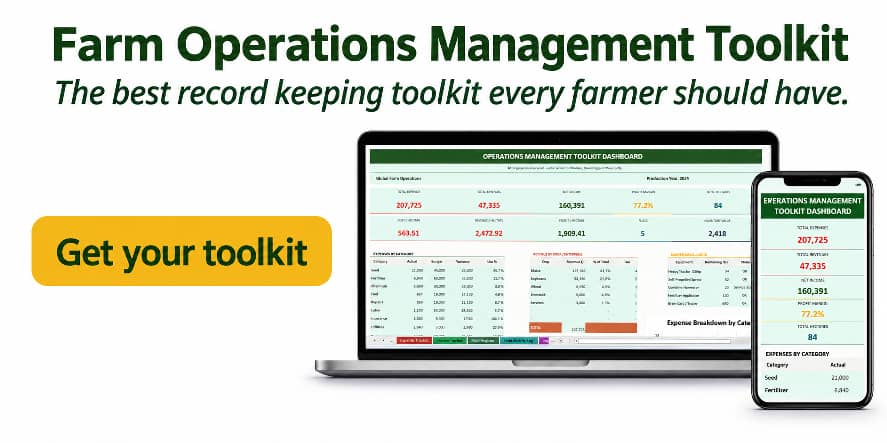
1. Keep records from this season. Write down every kwacha spent and every kwacha earned, including seed, fertiliser, chemicals, labour, transport, shelling, bags and storage. Test your soil, use the fertiliser rate that suits your field and keep field notes. Spending money on the right input is better than spending on more of the wrong one. Also, lenders ask for proof, and records also show you what really makes money on your land. Get a record keeping sheet here.
2. Know your cost per hectare and your break-even. Divide your total cost by the bags you harvest. That number is the lowest price at which you can sell without losing money. Any loan instalment must fit inside the profit you expect above that number.
3. Separate farm money from household money. Use a different mobile money wallet or bank account for the farm. Pay yourself a set amount after sales instead of dipping into farm money whenever the household needs something.
4. Plan the season on paper before borrowing. Write the budget, the planting dates, the expected yield and the expected selling price. Then ask whether the harvest can repay the loan if yield drops by one quarter.
5. Build a credit record now. Use mobile money or a bank account regularly, keep statements, and repay small loans and input credit on time. Farmers with a clean repayment history can help demonstrate creditworthiness hen approaching lenders.
6. Organise with other farmers. Cooperatives and farmer groups can buy inputs in bulk at lower prices, share transport, store together and negotiate better prices with buyers. Many lenders also prefer to lend to organised groups.
7. Understand loan conditions. Before accepting agricultural credit, ask about the interest rate, the total amount you will repay, the due date, penalties for late payment and any collateral. Make sure the due date falls after your expected harvest and sales.
8. Plan production and marketing together. Grow more than one crop, such as soya beans, groundnuts or sunflower alongside maize. Use drought-tolerant seed, conservation farming and, where you can, small-scale irrigation. Ask about crop insurance. Know your buyer before you plant. Look at out-grower contracts, Food Reserve Agency sales and warehouse receipts, since the new laws are meant to strengthen these routes. Selling at harvest when prices are lowest can make repayment hard.
Looking ahead
Ultimately, a sustainable farming enterprise requires more than access to inputs. It requires control over production costs, access to markets and the ability to generate sufficient returns to sustain future production. Start your records now so that you are ready when the details come out.
Farmers who know their costs, keep records and have a plan to sell will be in the best position, whatever form the support takes.