
When news headlines talk about the kwacha weakening against the US dollar, it’s easy to think, “That’s something for economists.” But it matters to farmers too. In this article, we look at what a moving Kwacha actually means for input costs, commodity pricing, and net margins this season.
In June 2026, the Zambian Kwacha strengthened to around K17.50–K17.95 per US dollar. By 26 October 2026, it had weakened to approximately K20 per dollar. That shift matters because farmers get squeezed as expensive farm inputs are tied to the US dollar, while local crop sales are paid in Kwacha.
Here’s what every farmer should know.
Why does the exchange rate matter?
Many of the products used on Zambian farms are imported or contain imported components. These include:
- Fertilizer
- Agrochemicals
- Fuel
- Irrigation equipment
- Tractors and spare parts
- Some seed varieties
When the kwacha loses value, importers need more kwacha to buy the same products from overseas. Those higher costs eventually reach farmers.
The problem is that costs rise faster than crop prices
Imagine fertilizer prices increase by 15%. You can’t simply increase the price of your maize by 15%.The market decides what your crop is worth, and buyers are often unwilling to pay more just because your production costs have increased.
This is why many farmers feel pressure on their profits during periods of currency weakness. Their costs go up first. Their income may not.
Which farmers are most affected?
Not every farming business feels the impact in the same way. Farmers who depend heavily on imported inputs, especially maize producers, often face the greatest pressure because fertilizer makes up a large share of production costs.
Livestock farmers can also be affected as feed ingredients, veterinary products and equipment become more expensive. On the other hand, farmers producing crops for export may be better protected. If they earn income linked to international markets, a weaker kwacha can increase the value of those earnings when converted into local currency.
| Farming Enterprise | How a Weaker Kwacha Can Affect You |
| Maize | Usually the most affected because fertilizer and fuel become more expensive, while maize prices often take longer to increase. |
| Soybeans & Export Crops | May benefit if export prices are strong, as earnings linked to international markets can offset higher input costs. |
| Livestock | Feed, veterinary products and equipment may become more expensive, increasing production costs. |
| Horticulture | Mixed impact. Input costs may rise, but farmers selling to export markets may receive better returns than those supplying only local markets. |
| Wheat | Higher production costs due to imported inputs, but growers with supply contracts may be better protected from price swings. |
Every farming business is different, but understanding where your enterprise sits can help you prepare for rising costs before they affect your bottom line.
Should farmers panic?
No.
Exchange rates move up and down all the time. What matters is how prepared your business is.
Farmers who leave all their input purchases until the last minute are more exposed to sudden price increases. Those who plan ahead often have more options.
What can you do?
While you can’t control the exchange rate, you can control how your farm responds. Consider these practical steps:
| If the Kwacha Weakens… | Consider Doing This |
| Imported inputs become more expensive | Buy key inputs early if prices are favourable. |
| Production costs increase | Use fertilizer and chemicals efficiently to reduce waste. |
| Profit margins become tighter | Keep accurate records so you know your true cost of production. |
| Prices become more unpredictable | Diversify your farm income instead of relying on one crop. |
| Cash flow becomes more important | Prepare a seasonal budget and avoid unnecessary borrowing. |
Small improvements in cost control can make a big difference when margins are tight.
Don’t focus only on yield
A record harvest doesn’t always mean a profitable season. If your production costs increase faster than the value of your crop, you can harvest more and still make less money. That’s why successful farmers don’t just measure yield. They measure profit.
A farmer who harvests slightly less while keeping production costs under control may earn more than one who produces a record crop at a very high cost.That’s why successful farming isn’t just about growing more. It’s about managing costs just as carefully as you manage your crop.
Conclusion
Rainfall isn’t the only thing farmers should be watching this season. The exchange rate can quietly influence the cost of nearly every input used on the farm. While no one can control the value of the kwacha, every farmer can control how they plan, budget and manage costs. In uncertain times, good financial management becomes just as important as good crop management.
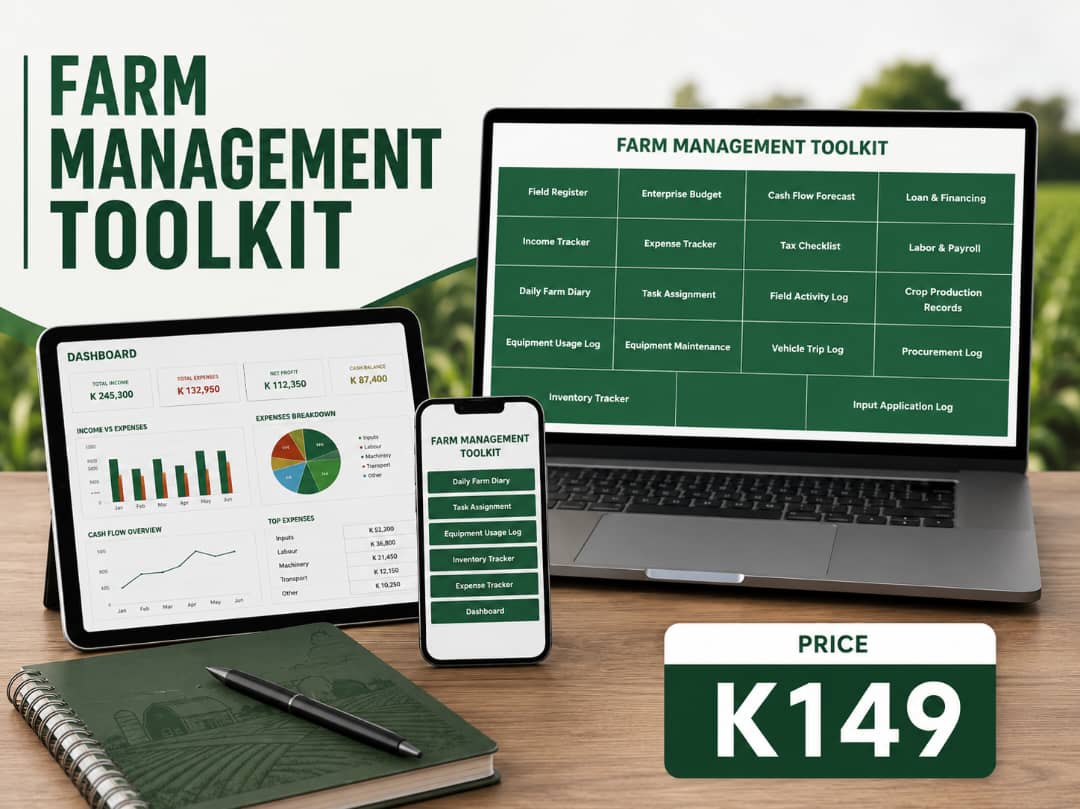
Get a complete farm operations management toolkit and manage your farm better